Every time we automate a task, we create three new ones
When I built LUPNUMBER® at LUP Technologies, the product did one thing: it replaced manual safety communication at industrial sites. Before our platform, operators at construction sites and factories communicated hazards by shouting across loading docks, running between buildings, and hoping the right driver got the message before turning the wrong corner.
After deployment, the shouting stopped. Operators stopped running. The site got quieter.
It did not get emptier.
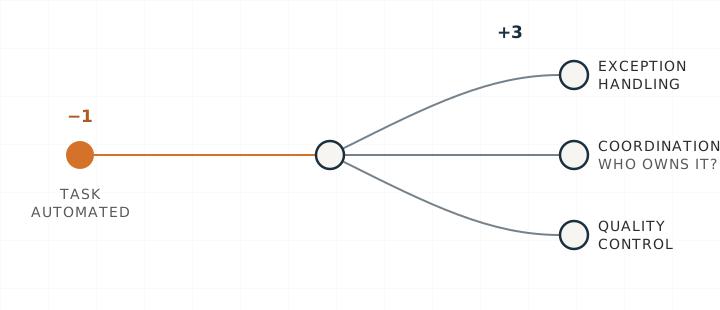
What happened was that people who previously spent their days relaying basic safety information now had time to plan. They started coordinating vehicle flows. They began updating site maps proactively. They created pre-arrival briefings that reduced on-site incidents. The automation of one task (relay safety info) created three tasks that had not existed before (plan flows, maintain maps, brief drivers).
Nobody lost their job. The jobs changed.
The Jevons pattern
I think about this every time someone frames AI as a headcount reduction tool. The framing misses something fundamental, and it is not new. William Stanley Jevons described it in 1865 with coal and steam engines. When engines became more efficient, coal consumption went up. Not down. More efficient engines made more applications viable. Demand expanded faster than efficiency improved.
The same thing happened with spreadsheets. When VisiCalc and later Excel arrived, the prediction was obvious: fewer financial analysts. A spreadsheet does in seconds what used to take a team of clerks all week. The actual result was the opposite. The US had roughly 350,000 financial analysts and personal financial advisors in 1980. By 2020, that number was above 700,000 (Bureau of Labor Statistics). We did not need fewer analysts. We needed more, because suddenly every department could model scenarios, run projections and build business cases. The volume of financial work exploded.
AI is doing the same thing right now. I use Claude to write code. I have written code for years. The AI does not reduce the amount of code I write. It means I ship features that I would not have attempted before. Each shipped feature creates documentation needs, testing requirements, user feedback loops and integration problems that did not exist last week. My to-do list is longer with AI than without it.
The wrong question
My assessment is that organisations are asking the wrong question. “How many people can we cut?” is a question about static capacity. The right question is: “What could this team do if every member were twice as fast?” That question leads to expansion, not reduction.
There are two types of organisations in this shift. The first type sees AI as a cost tool. They automate tasks, reduce headcount, and report savings to the board. They get a one-time efficiency gain. Then they hit a wall, because they removed the people who could have identified what to do next.
Organisations that treat AI as a capacity tool instead keep their people, accelerate their output, and discover that the bottleneck was never labour cost. The bottleneck was all the work they could not afford to attempt. With AI, those projects become viable. The demand for human judgment, coordination and context goes up.
What the backlog actually looks like
I saw this pattern at Volvo Group. Large organisations generate enormous amounts of work that never gets done. Not because the work is unimportant, but because prioritisation forces everything below the top ten off the list. AI does not eliminate the list. It makes positions eleven through fifty suddenly achievable. Each of those projects needs someone to own it, evaluate the output, and connect it to what the organisation already knows.
This is Jevons, applied to cognition. Cheaper thinking does not produce less demand for thinkers. It produces more demand. The organisations that understand this will hire; those that do not will cut, save money for a quarter, and then discover they have no one left who knows what to build next.
If you are making AI deployment decisions, I would suggest one reframe. Do not ask what your team can stop doing. Ask what they would start doing if the cost of their current work dropped by half. The answer is probably a longer list than you expect.